


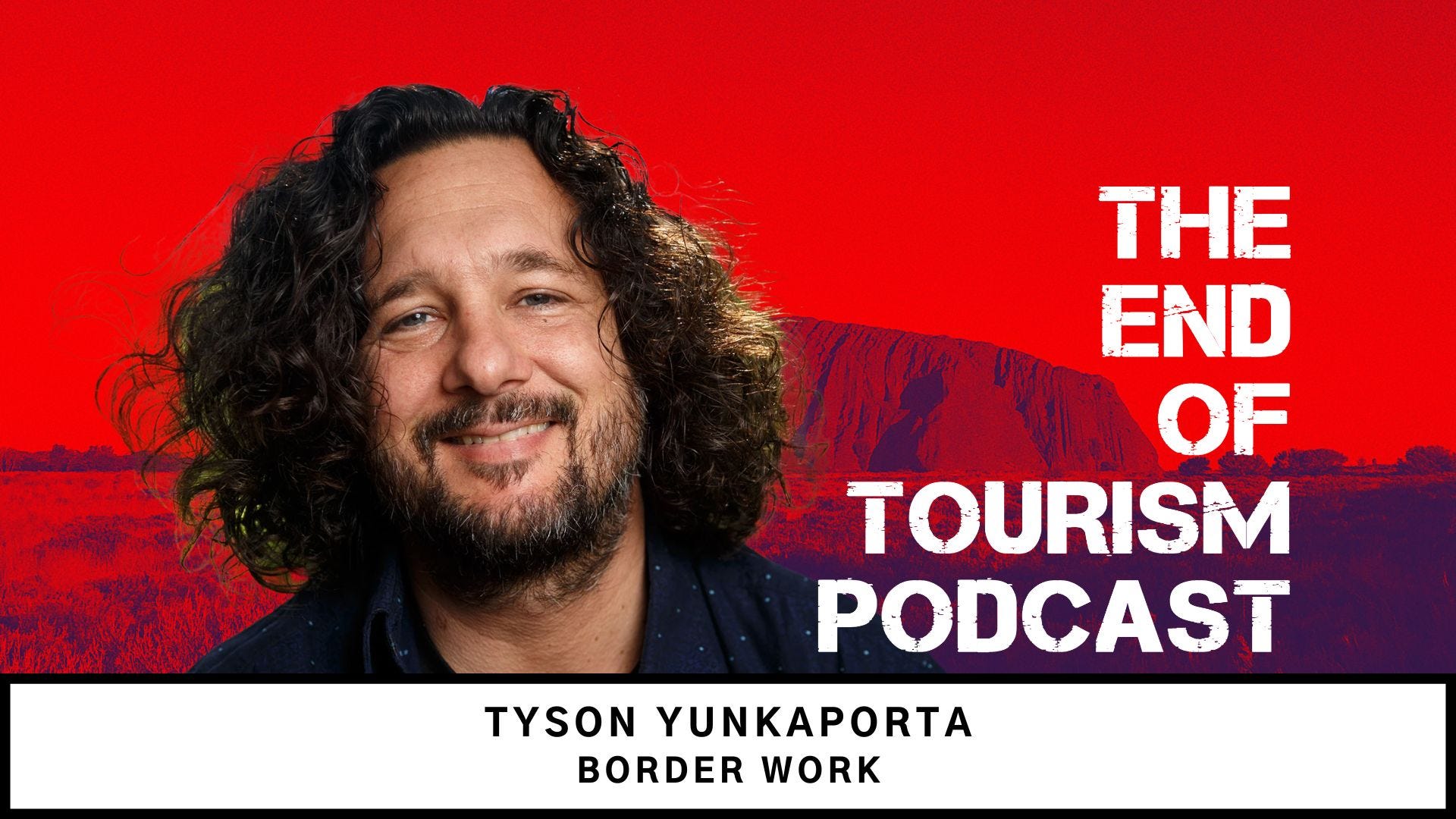
My guest on this episode is Tyson Yunkaporta, an Aboriginal Australian scholar and member of the Apalech Clan in far north Queensland. He founded the Indigenous Knowledge Systems Lab at Deakin University and wrote Sand Talk: How Indigenous Thinking Can Save the World, which examines how Aboriginal methods of inquiry address contemporary ecological and social challenges. In 2025, his second book, Right Story, Wrong Story: How To Have Fearless Conversations in Hell was released.
Tyson’s work brings Aboriginal ways of knowing into dialogue with complexity science, examining how Indigenous thought represents systems thinking developed over tens of thousands of years. His methodology honours Aboriginal traditions of knowledge creation through “yarning” - collaborative dialogue through stories and mutual respect - and “sand talk,” the practice of drawing symbols in earth to convey complex ideas.
Show Notes
Magpie Migrations
Making ceremony among tourists
From sacred entities to souvenirs
Lawful voyaging: the three pillars of ancestral travel
Culture-bound syndrome / sorry rocks
Telling story / experiencing the more-than-human
Sex tourism: The twisted impulses of sexual energy
If you don’t move with the land, the land will move you
Men’s and women’s business
Falling in love with travel
Homework
Transcript
Chris: [00:00:00] Welcome to the End of Tourism Podcast, Tyson.
Tyson: Yeah. Good to see you.
Chris: Yeah. I’d like to extend my gratitude to you for your willingness to join me today, given certainly all of the obligations you have to your people and place. And I’m wondering if you’d be willing to share with me, with our listeners, where you’re situated today, in your days and in the world at large.
Tyson: Yeah. I’m on Bunurong Country, down at the bottom of Australia. Melbourne, here. Yeah, and it’s coming into winter time, but it has changed in the few years that I’ve been here. Winter’s not as harsh, as fast. We kind of had a really long, what they call “Indian summer,” recently. Yeah. And a few weeks back, all the ants started mating and grew their wings, and everything that happens around [00:01:00] that just sort of took off. I know a lot of people think of springtime as a time for birds and eggs and mating and everything, but there’s always something.
So the big birds, your eagles and live birds and turkeys and geese, et cetera, in this cold time, they’re all mating, dancing. Everything’s sexual. All the time. There aren’t any dead seasons. Yeah. There’s always, always something kicking off.
And the bats have just left and the Magpie larks left a few weeks back, a couple of weeks ago, went north. Yeah. So, everywhere, the place is also the time. So we have time and place in our indigenous languages. So I’m three and a half thousand kilometres south of home, up in the north of Queensland, there. [00:02:00] I belong to Apelach clan. And a lot of the birds that were here, recently, and bats and things, they’ve flown north up there. The magpie geese and things like that. Magpie larks. A lot of black and white things have flow north there.
And I guess, yeah, place and time, in our way it’s the same word usually, or the same prefix or suffix in a lot of our indigenous languages. Yeah, because the time is the place because everything’s moving. These locations we inhabit, they’re not static sort of territories. There’s always human and non-human movement within and across bioregions and over vast distances. Voyaging and migration is just how we all behave.
All human [00:03:00] and non-human entities, moving. And even if they’re fixed like a tree, they’re exchanging information, nutrient seeds, leaves, dirt, et cetera, over vast distances, which is exciting, I think. And, lots of us partner with those things and help out with their seed dispersal, and all that sort of thing.
And that’s a kind of an evolutionary mutualism, a collectivism that’s sort of developed over time. There are always flows. And so yeah, I’m just kind of flowing with this place now, but my mind is in other places, following species that mean something to me, that have travelled vast distances. All the little sandpipers from here just flew up to [00:04:00] Siberia.
Chris: Wow.
Tyson: Yeah. A while back. So I know that’s kind of cool. And here I am and you are there. Started out in Toronto and went all around voyaging. And now you’ve ended up, there where you’re sitting now.
Chris: Yeah. In this place that is kind of contending with extreme heat. It’s that time of year. Yeah. In this place. And the June bugs and the cicadas are starting to sing, starting to recognise the time of year here and...
Tyson: Oh, that’s exciting.
Chris: ...pray in the ways that they do for the rains.
Tyson: Do they come yearly or every few years? The cicada’s there.
Chris: Usually every year.
But I think it’s, from the little I understand of the regeneration qualities, they’re probably on different cycles every year.
Tyson: Yeah. Yeah. The cicadian rhythms. Hey!
Chris: [00:05:00] Well, thank you for sharing that with me. I think, there’s so many of these little, kind of biocultural resonances that so many urban people like myself and, and modern people have, either just not been taught about or been taught to forsake in some way. And, I remember the couple of times I spent, there in those lands, in what today is called by many “Australia,” as a backpacker and as a tourist, as a younger man, I remember travelling through those lands and not having any sense or context or even want to understand the voices of the places that I was travelling through, then and there, as I made my way from Cannes to Sydney, and then Melbourne, and many places in between, largely as a tourist, right? Mm-hmm.
[00:06:00] And, so, I’m curious, I could wax on and on about my experiences and, and the lack of, perhaps humility and adequate guest that I proceeded with as a younger person. But I’m curious about your experiences, with the consequences of tourism, either in your own life or in those of the people that you call yours in those lands.
Mm-hmm.
Tyson: Ah, well, I guess the last time I sort of, I went somewhere for ceremony, a while back, it was in the Bunya Mountains, which is a really sort of sacred place and gathering place. People from far afield, all around Australia used to come there, and still do, every three years, because that’s when the Bunya harvest happens.
The bunya nuts are very fat, every three years. So it’s the tree that calls people in, and there’s big ceremony there. And you have to travel the right way. [00:07:00] In the global south in general, and indigenous people’s, there’s very different border work.
Borders aren’t about territories, but they’re more about sites of ceremony increase, where you negotiate the norms of access, the flows. Even animals, as they move between sort of one bioregional area and the next, they pause at the edge and they do things. That’s naturally what we do. We make sure we’re respecting the place we’re going into and, that we’re making connections, with each other.
So I guess the last time I went for that, travelling in the same way, coming into the same way, traditionally, we went to a very sacred site, where there’s like a bit of a waterfall and a big pond and cliffs. And we were sort of there [00:08:00] trying to do our cultural business, and that ceremonies that bring increase to the land. And there were tourists there, jumping off the waterfall into the pond, and a couple of people were just like having sex in the pond like this, like euro-trash tourists kind of thing.
And I think that’s the biggest thing in Australia. Like a lot of our most sacred places are sort of treated as recreational facilities for people to visit and “you know being in da nature. And it’s very much enjoying the waterfall. It’s very good for diving and swimming.”
Yeah. So of course we have the most sacred place is in the centre of Australia - Uluru, Uluru what they used to call “Ayer’s Rock.” Yeah. And, it’s just, it’s taboo. Like none of us, even the most senior elders, can sort of [00:09:00] go up onto that rock. It’s like there are a lot of sacred places like that all over Australia that they’re so powerful and so sacred, they’ll make you sick, and people can’t go there. They disrupt the place. And the lots of tourists for so long have been climbing the rock. It’s one of the things you do when you visit there. You sort of climb up on the top and go, “oh yeah, I’m at the top of the world here.”
That’s something I never understood was mountain climbing. Like, why would anyone want to do that? Anyway. Yeah. So, there’s all that and there’s of course people want buy things, trinkets and such. People wanna buy authentic things. But for us, an object or an image, or a sculpture...
So I mean, this one here, which is a swamp hen carving. I know that this is an audio medium, so no one can see it, but yeah, that’s a [00:10:00] sacred totemic entity, and each carving or image of that carries part of its spirit and its power, so if my children come near it, I have to put my smell on them to make sure they don’t get sick from being near it.
But if too many of these are made, it depletes the spirit of the thing. And so, if you make a thousand of them, that spirit gets divided among all those images, and they become weak, so they’re no longer dangerous or powerful things. And so a lot of our images and entities and stuff like that are replicated millions of times [over] for tourist artifacts and things like that.
So, tourism was always extractive, and much of it involves a kind of imperial nostalgia, this sense from the Age of Discovery and the [00:11:00] empires (French, British, Spanish), the idea that you could go anywhere in the world to these exotic locations, and there would be a table waiting for you. And there’d be slaves and servants and guides and porters, backpacking. In the old days, you didn’t have to carry your own backpack. You could take almost everything and have like twelve black guys carrying it for you. And I guess, tourism throughout Asia and Oceania and Africa, it’s giving that sort of imperial nostalgia, that feeling of going somewhere and experiencing that early colonial kind of luxury, where people were like kings in these places where they stole the land. And yeah, just enjoying very cheap service from locals, and having guides - native guides - take them places, and then getting to be the big boy now being brought into some kind of [00:12:00] ceremony or ritual thing.
A lot of that, psychedelic sort of tourism in South America with the ayahuasca and everything like that. Yeah, so you have guides taking you through to these sacred places or doing sacred things and it’s kind of a dilution that happens, because it’s extractive. You are taking something. You are taking something from the spirit of that place by coming in that way.
And it’s just bad border work, with that idea of borders as walls, where, if you have privilege you have access, and therefore keeping undesirable things out and keeping other things in. Yeah. So, a world of walls and borders and expansionism and all this kind of thing.
Yeah, tourism is a really interesting process for [00:13:00] people. It’s like even underprivileged people, they do that to experience that. You have a holiday, you save up all year for two weeks so you can experience the life of a wealthy person, of the wealth class for a couple of weeks, and access these places and feel the privilege that your nationality, if you belong to an imperial nation or a colonial sort of settler state that you get to enjoy and experience that enormous privilege, for the people to whom all that wealth was accrued, wealth and resources, over the whole colonial era and then the neocolonialism of now.
So you save up all year. You work your ass off, in a job that you hate, so you can enjoy that couple of weeks of immense privilege, a privilege that once belonged to all the people of the [00:14:00] earth. You know, because our first law, our indigenous laws, they seem to have, universally, the same three sort of principles, pillars, of like, no bosses: nobody can force you to do anything. Freedom to choose, freedom to say “no.”
And then there’s the freedom of affiliation, that you can change affiliation with families, clans, and belong in another culture if you choose to. And, so in the old days here, everybody spoke like a dozen different languages, because people would voyage and trade and adopt and marry and spend time in a lot of different countries, here.
And the last one is freedom of movement, freedom to travel and voyage. So, at some stage, most human beings enjoyed that [00:15:00] right and that privilege. But, travelling the right way and coming into places the right way, or we might call “ lawful voyaging.” This is a lawful voyaging, the same as the animals do it. The crows are lawful voyagers. The cranes, the geese, all these different migratory species. And the flows of winds and waters, and all these human and non-human entities, lawfully voyaging in the right way with that respect.
And then I guess there’s lawless voyaging. And so. where in the old days, we would trade things, like different plants or species, and then we’d bring those things in the right way and make sure people were responsible for them as totems, and would be responsible for integrating them into the ecosystem so they didn’t behave invasively or disrupt things too much. Yeah, we’ve always done that, which is why there are [00:16:00] a lot of species that have had a global distribution for tens of thousands of years or more, even hundreds of thousands of years, that they have distribution all over, because people have traded those things and done it the right way.
But I guess in the lawless voyaging, people take things with them, which is not the right way. It’s more like trafficking. So, lots of species now are trafficked, and going to places and cause massive disruptions in the ecosystem, et cetera. Yeah. And I guess the people do, too. There are people who are ferals and weeds, and behave in that way when they land somewhere. They do very well and they proliferate themselves, but they don’t proliferate the rest of life in a place. You should be bringing something to the places you go to where you are [00:17:00] adding to the life force and to the regenerative health of that place, you’re adding to the diversity of the place, you are bringing something. Because that’s the purpose of voyaging. It’s a gift of giving, and the more places you enrich, then the more these vast networks of interconnected systems become enriched. And over the course of your life, all of that comes back in massive abundance to you. You are investing for regenerative futures all the time, and there’s real joy in that.
Yeah. And then you’re hosted. So, if I go to Turtle Island, and I’ve travelled there the right way and been brought in the right way, and so I know which clans are responsible for me and that I answer to while I’m there if I do the wrong [00:18:00] thing, but also will host me so I know that I’ll always have a place to sleep and something to eat. If I find that moose clan people or turtle people or crane people there, those clans will look after me anywhere on the island, on Turtle Island. Because I can speak that and talk about the people who brought me in that way. And then those people, anywhere I land there, they’ll look out after me. Yeah, so it’s like a massive Airbnb, when you travel with those credentials. And so you’re hosted and you are a good guest, a lawful guest in that place.
Chris: Hmm.
Hmm. Wow. Thank you Tyson.
Mm-hmm. There was, a quote in your book that came up for me, when you were mentioning Uluru and, I think it’s in Sand Talk, and you write that,
“there in Uluru there’s a shed full of rocks, [00:19:00] and that for a long time tourists took stones away from that sacred site as souvenirs. Then, a few decades ago, something strange began to happen. The tourists started mailing the rocks back with panicked reports of weird happenings, disturbed sleep, bad luck, ghostly visitations, and terrible accidents.”
Tyson: Hmm. And sickness. Yeah, in psychology, they call it a “culture-bound syndrome,” and there’s a lot of like very specific, mental illness categories for aboriginal people, aboriginal Torres Strait Islander people here. And, yeah, one of those has been studied and is presented as part of the psychology canon, for people when they’re working with indigenous people. Psychologists. Yeah, there are a number of mental illnesses with really specific profiles [00:20:00] of symptoms that doesn’t really show up in anything else.
When I was getting treated for bipolar, for my horrific bipolar disorder, they kind of had to sift through and pull out the symptoms that just did not fit with bipolar or anything else, including fugue states and things like that.
I was lucky enough to have an aboriginal psychologist I had access to, who could help them separate all those things out. So we had a set of treatments for the bipolar, with medication and therapy. And then there was the rest of it that I had to work through as well. So yeah, what we call “sorry rocks,” that’s the Uluru rock phenomenon you were talking about. But that just happens all the time, people picking up rocks in the land and [00:21:00] then taking them away and getting sick from those things. And there’s a really specific treatment protocol that I know for that, that I was trained up to do in the traditional way.
And you have to take that person back to that place with the rocks, and you have to call out to the entities of that place, the ancestors. You gotta call out and explain to them, loudly, what’s going on: “ I’m returning them back.” And then, the other person has to call out, “I’m putting these back here... please stop tormenting me.”
And then, they’ve gotta walk back exactly on the tracks that you came in on. And then, I’ve gotta walk backwards behind them, brushing with leaves, a branch of leaves, [00:22:00] brushing the tracks away, like aromatic leaves, so that we’re not leaving our scent there, or the tracks, for those things to follow us out. And you have to get that bad spirit out of the person there, and then it has to stay there with the rocks.
And then, when you get to the edge, this is that border work. boundaries are places for making sure you’re not bringing things across when you go out. You are not taking anything, but also that you’re not bringing things in that are going to harm the place, either. So that’s where you sit and rest and come into relation with the place and with the entities of the place, or if you’re lucky enough, the people of that place.
So, it’s always good to pause before you walk into these beautiful places, and pause on your way out too.
So then, the two branches are brushing off that person. You’ve gotta brush right quite [00:23:00] vigorously and shake the leaves from the head to toe, right down the front and back as well, and then hit the branches on the ground to flick that stuff away. And then, smoke. Make smoke and make sure they’re bathing the smoke really well there. And then, right there, you leave the coals of that fire warm there in that place. Make sure they’re not gonna blow away, bank ‘em up so they don’t blow away and start a wrong fire.
And then, you brush the tracks, again, away from the fire, and leave out the same way you came in, and drive away as fast as you can though. And so, the bad stuff that’s gonna follow the person, it’ll stop there at the fire, for the warmth. And yeah, I’ve successfully done that a couple of times.
Chris: Wow.
Tyson: And helping with treating people. [00:24:00] And so that goes with anything, because you might not pick up a rock, but you’d be in a place and you’ll pick up something. Some places it’s good to make sure you are sort of looking at the ground and you’re not like looking all around too much.
Chris: Yeah.
Tyson: If you see something like a bright spot or something interesting that really grabs your attention, you don’t want to stare at it too much and really approach it. If you hear something, on the edge of your vision, you’re not sure and you’re like focusing in on it... there are disembodied things that seek embodiment. And they might seek embodiment in you, moving through there.
Which is kind of how I look at a lot of, AI, because these are invisible things, entities. [00:25:00] And they do have patterns and patternings of intelligent-like sort of expression and stuff like that. So they are existing things, entities, but in that invisible way. So, I sort of regard them always as seeking embodiment, so you use them carefully, and keep yourself clean, try to make sure you’re not carrying any of those patterns away, if you use that tool.
So, I’m talking about all the bad tourist things, but we should probably talk about the good things too, like as humans, because we all have that same patterning, of what it is to be human. We all hate bosses. We all seek to have freedom of movement, and seek to affiliate with who we want to affiliate with, and make relationships.
And I don’t know. So I ask you that: [00:26:00] is that always like the biggest and most satisfying thing that you take away where you also put back the same amount, and you feel that connection forever with that place? Is it the relationships, that you make there, when you meet locals or other travellers from other places and you form these strong bonds and memories and connections that last a lifetime? Is that the big thing?
And it might even be making non-human relations, with a tree or a species or a body of water even, or a land form. You come into a relation with that and it’s the relationship that enriches you. I wouldn’t mind hearing your thoughts on that, just as a young fellow, like particularly, too naively travelling and you spoke about the wrongness of how you did it, a lot of it. But I bet there was a lot of rightness to where you were just following your instinctive, human patterning of being somebody who [00:27:00] generates, regenerates, increase. And, yeah, increase, not like growth. Increase is about connections, like creating more diverse infinite connections and relationships in places and across places.
Yeah. What was your experience of that?
Chris: Well, I mean, I think that there’s certainly a degree of human connection that was everywhere, but at the same time, in terms of any kind of qualitative, hospitable, and when I say hospitable, I refer to the willingness of both a potential guest and host, a local and a visitor, to engage each other on the terms of the place and the time, and to do so with, as you said, a degree of [00:28:00] respect for the other that is largely unknown, in the sense that the visitor, often, is largely, a stranger to that place and a stranger to that time, if we’re gonna speak of them as one, interwoven kind of concept.
And, I met a lot of people and I visit a lot of places, and there are only a handful of moments and a handful of people that carry a degree of weight in my memory and in my days that are still very much alive in this life and in my willingness to remember them and to connect with them. And I think a large part of that comes from the kind of infrastructures, the tourism infrastructures that are not necessarily solely beholden to the “destinations” that people go [00:29:00] to, that those notions of how to behave elsewhere come from how people are taught to behave in their home places, how they’re taught to understand hospitality, within the urban or modern context as something that, can be bought and sold, something that’s standardised across all cultures, geographies, calendars, and then of course that’s then, brought in the carry on baggage of people. And that’s the unrecognised or unconsidered, expectation of the visitor that’s then projected upon the host. And so, when you find something, or when you encounter someone or some moment that not only challenges, but even undermines that, I think it’s something that can [00:30:00] be really beautiful.
And I was very lucky, despite having grown up in a major metropolitan western city, to have the lived memory of my grandparents who were peasant farmers in the Balkans before they came to Canada, and that the hospitality, the kind of radical, rooted, local hospitality that they practised in the quote unquote “old country” was still very much alive in the new one.
And then, I got to grow up with them, largely raised by them and got to kind of have that as this kind of memory, this kind of amulet of memory that I could take with me, and not necessarily consciously, but something that, when that kind of hospitality showed up, I had the ability to have a point of reference for it within my own days, in my family, which, [00:31:00] I think that a lot of people that I grew up with and a lot of people in the places, like the place that I came from, don’t have that lived memory anymore. I mean, I also worked a more or less a decade in the hotel and restaurant industries and catering and all that, so, I definitely also saw the other side of that. So I think there’s this sense that when people travel, when they engage in what we call tourism, there is this kind of longing for some kind of live the memory of what that either was like, how it might be in other places, how it could still be for them.
Tyson: Well, your peak moments are always moments of profound connection of coming into relation. You hear people telling their stories, and they always wanna tell story. And I don’t know, there’s this western sort of eye-rolling thing, of “Oh my God, please not [00:32:00] the slideshow. Ah, don’t show me all your holiday pictures, Jesus.”
But that should be something that’s revered, and that people love to receive, because everyone has been on that holiday, and then they come back and they want to share. They want to share, and it’s always stories of relation. No matter where people come from or no matter how disconnected they are from their biology or anything else, or the land. Sharing story, that’s so important. That’s what travel is, and that’s one of the things you bring to places too, when you leave there. You know, it’s your stories that you bring when you meet people, and then the stories that you bring back. It’s so important. Just the informatics of that are mind-blowing. And you see, when they talk about their peak experiences, it’s never just the parasailing or the snorkelling. It wasn’t like, “I snorkelled the Great Barrier Reef.” And, [00:33:00] what they talk about is profound moments of connection, like when they sort of swam right up to a grouper or a grouper swam up to them, or a dolphin or something, and they connected with it and they can’t quite put words to it, but that was their profound moment, of coming into relation with a non-human.
But then also, all they want to talk about is bloody Gregor, who was, I don’t know who was their helper on the boat, who was their guide. You know what I mean? It’s about “how great he was,” and they want to talk about him, and “little Shelly who was the concierge at the motel, and she was so generous, and we had sat down and she told us all about her grandparents,” and all this sort of thing. They talk about the relation. Their peak experiences are always [00:34:00] around that, and their fond memories is around the relationships. Because we know instinctively that that’s why we’re travelling. You are potentially connected to everything in the universe, in one way or another. And it’s kind of like your purpose on earth is to realise as many of those connections as you can to proliferate your networks of relations, because that’s what you are, and the more variation and just abundant diversity in those relations that you can create, as far afield as possible. That’s what makes you. That’s what grows you and makes you everything that you can be. And there’s just infinite satisfaction, need-satisfaction in doing that, becoming that.
I started talking right at the start, and so I’m gonna start another thread here. And I know I’ve been talking for ages, but I’m gonna do it [00:35:00] again and I started at the start talking about how sexual everything is - in the land. And that’s us too, we’re sexual. And when we travel, we leave pieces of ourselves - our smell, our skin cells, our hair, parts of our biology stay there. And the ants take those pieces down into the ground, and they end up in tree roots and then into the trees and our memory and our patterning is there in that place, forever. So it has a memory, and memories that we bring and information that we bring from far afield. When you’re in a place, it’s always the season for something mating, and it’s the task of everything around it. Even if it’s not their season for procreating, they still belong in that sexual ceremony.
So the mag pies here, these, very pointy-beaked things. It’s not their mating season [00:36:00] now, but it is their singing season, because they’re singing the love songs for all the other things that are mating now. And so, your sexual behaviour isn’t limited to one time and for one purpose. It’s continuous with every species. If a tree is flowering, that’s its time. But then also, when it’s not flowering and it’s not its reproductive time, then it’s exuding scents and sounds with the different kinds of winds that come in that season that will be part of the ceremony for everything else.
And so, when we travel and we come into a place, we pick up all these like increased signals from the land, all of this love/magic ceremony, that’s going on all around us. And we feel that. And I guess, if you go into a new place, you are receiving signals from that place [00:37:00] that you might not notice in the places familiar to you, because it’s also new. It’s hitting you raw, even if you’re not conscious of it. And so you do become excited, and you are seeking, as a sexual being, in that place, that new place. And that’s always been a really big part of diplomacy, embassy, meeting, for ceremony between different groups. When you’re coming into new places, the idea is to come into relation, so you either have a sort of a temporary adoptive status, or you figure out how your grandfather might have travelled there, and then, okay, so what did he call somebody? He called him “uncle.” So, all right, well, you and I will call each other “cousin” or “brother,” you know what I mean?
Chris: Mm-hmm.
Tyson: But if that prior relation isn’t there, then you have to have some kind of adoption through. So you connect with somebody you know, who might want to call you “brother,” [00:38:00] and then you call his uncles “uncle.”
You know what I mean? That kind of thing.
And you come into a relation that way. But then there’s also like that kind of marrying in, which doesn’t have to be a marriage, it can just be a sexual relationship or a romantic relationship. It may or may not be consummated, but it can just be flirty or something like that. But you know, that ultimate kind of exchange is to exchange biology - your biology with someone from that place. And you feel driven to do that, because that’s how we proliferate genetic diversity, in our species, that keeps the species vigorous. It’s to mate with those who are unlike you, who aren’t from the same gene pool.
So you feel very driven to do that. So there is that real drive, like whether you are actually having any romantic hookups or anything like [00:39:00] that. Still, it’s, very much, a profound sexual drive when you voyage, when you go to new places. You feel that very strongly, whether you realise it or not. And that’s part of that sort of big dopamine. Like, you must have felt it when you were young, just that you’re on a high, for travelling in the place.
Chris: Absolutely.
Tyson: And, yeah. And I’d say at least half of that is the same as like feeling the same feeling and chemical cocktail of when you fall in love. You feel like you’re in love. And so you do, you fall in love like stupidly, immediately.
Oh man. When I went to Africa, it was like everything around me was like sexual signals coming in. And I’m looking at like these people in Uganda. I’m like, every single person I see is like, I’m seeing thousands of thousands of [00:40:00] thousands of people. Young and old, big, little, fat, skinny. And they’re all like, just, “oh my God, they’re all really sexy.” And they walk there, culturally, they walk in different ways from how we walk here. And I’m looking at how they walking and I’m like, “oh my God, that’s like, oh, that’s the sexiest thing I’ve ever seen.”
And so, I found the time that I was there, I just felt on fire the whole time. And I guess, I don’t know, if you come from a culture where sexuality is like repressed, then it kind of gets driven underground and twisted into fetishes, and particularly if you’re coming from a colonising or imperial culture, power relations get mixed up in that.
And so the idea of dominating or being dominated is a lot of that kind of kink, and that sort of appeal and intensifier for you. And [00:41:00] people chase that like an addiction. And so that’s how you end up with what’s basically a really good and pure and natural impulse when you travel. And that feeling is supposed to make you connect and relate, and have a stake through intense relationships, have a stake in that place, to care for that place and the people through that connection. That gets twisted - that impulse. And so, then you end up with the sex tourism.
Chris: Right.
Tyson: And a lot of that is fetishized stuff around power relations. It’s sort of part of that imperial nostalgia around the rape and pillage of these places, and the sort of high excitement and drama of that. Particularly, in Asia, you’ll find this sexual tourism. People are coming to have those experiences that are [00:42:00] not acceptable in their culture or even illegal in their place of origin, and they want to go and do those things, in that kind of twisted, unbalanced power relation. They want to experience the domination that their grandfathers and great-grandfathers experienced, coming into a place, and just pillaging the hell out of it. Yeah.
And so, yeah, if your sexuality is twisted, everything’s twisted. And that’s what like capital and top-down sort of hierarchies do to the people. It twists them at the most fundamental level.
And that border work I was telling you about before, of the Global South. And you find out with lots of minorities and even like LGBTQI+ plus community, they have that more flowing border work, but that other side border work that’s very much in the Global [00:43:00] North of those imperial cultures and that recent invention of nations, that’s only just over a century old, this border workers is iron.
And it’s not just for national and state borders, it’s for people as well and family. So the idea of what a family is, there’s borders around that, and what is normal and what is a polluted or toxic or contagious influence. You can’t let those things in, like gayness and stuff like that. So there’s border work that’s happening all the time. And it’s bad border work like that.
And then there’s even just your personal border work, because you have your boundaries. And the best thing about boundaries is bringing those boundaries up, up and overlapping with another person’s boundaries. And the negotiation of a relation, in that third space where you create a third entity, of your relationship. That is just exhilarating, because you’re driven to do that kind of [00:44:00] border work. But if you are in a society where you have to be competitive with others to survive, then your border work’s gonna be wrong.
And that’s what... consent is the centre of everything, because that’s what happens at borders, is consent. But it’s more than that. Consent is like something beautiful, and you can see it more in the word “con-sensual,” like feeling together. And there is a sensuality to it. It’s the most intoxicating and uplifting thing - is you’re creating consent.
So, when you enter a beautiful place as a tourist, you are stopping at the edge of that place and bringing your boundary of you and all the relations and identities that you’re bringing. You’re bringing that to that border and you’re creating that beautiful consensuality with place. But that gets twisted, right?
Consent, the violation of a boundary, the violation of consent is something that tourists do. [00:45:00] And that’s exhilarating to do that. I’ve done that. I did that when I went to Pompeii. And that place just, that set me on fire - the spirit of that place - and I didn’t come in the right way.
Chris: Wow.
Tyson: I was just all over that place. I’m stepping on things that are crumbling under my feet where I’m not supposed to walk, because “damn it, I want to go.” Like, you see this sort of tunnel and there’s a fence in front of it saying, “do not enter.”
And I’m like, “damn, I’m going in there.” So I penetrate this tunnel and I want to Indiana Jones that place. “I want to go into the tombs and stuff. I want see the stuff I’m not supposed to see. I want to take the things that I’m not supposed to take.” I remember doing that.
And I still remember how exhilarating it was to do that, but like the damage there of me just kind of violating the boundaries of that place, and [00:46:00] violating that respectful relation of a place that was frozen in a moment of time under something as powerful and sacred as a volcano. It’s a very sacred site, and I did the same thing to it that tourists do to Uluru here.
Chris: Mm-hmm.
Tyson: Yeah. And I don’t know. It was when I was much younger, but I did have a few bad years after I did that.
Chris: Mm-hmm.
Tyson: I was getting tormented, and it’s probably damaged me in a lot of ways that are permanent. It probably took a few years off my life doing that. But still, my heart’s racing thinking about it. It was so freaking exciting to invade and tomb raid that place. And that’s a telling thing, isn’t it? “Tomb Raider.” You’re raiding somewhere. Anyway, so I reckon that it’s that kind of excitement that’s behind [00:47:00] the worst of the sexual tourism and everything else.
Chris: Mm-hmm.
Tyson: But, yeah, that’s the stuff that doesn’t go in the slideshow - the sexual encounters. People come back with secrets. People come back with very intense brief relationships they’ve had physically with people, and they kind of cherish those forever. But that was that drive to be somewhere and come into embassy, an embassy kind of relation with people of different places.
Voyaging is what we do as humans.
Chris: When you were mentioning that just now, I was reminded of a quote in one of your books. And I think it speaks to the broader, perhaps, lawless voyaging of the last centuries. Somewhere in there, you say something to the extent of, “if you don’t move [00:48:00] with the land, or perhaps if you don’t move well with the land, the land will move you.”
And, I’m curious in the context, maybe not just of tourism, but also migration, and you also mentioned the consequences of the nation, the nationalism of our times, what that notion means to you, that the land will move you if you don’t learn to move with it, perhaps in the ways that serves the land.
Mm-hmm.
Tyson: Yeah. That’s it. Well, I guess the desire is to sort of freeze things, sort of conform with this Abrahamic religious idea of there being a single God, and everything that sits outside of God is evil, but God made a creation and a perfect creation, and he put the zebras there, and that’s where they are, and he put the black people [00:49:00] here, and that is their place. And I guess this is part of where the bad border work comes from, this idea of territories that God has declared are yours in perpetuity, and that anything that moves across those borders is evil and outsider and other. I think that’s what’s sort of at the heart of things, nationalism and aggressive ethnostate kind of moves.
This is always like the impulse behind fascism and autocracy, and the rest. And then you need that hierarchical governance. You need that abuse and that aggressive border work of every individual in order to dominate or compete within these systems. And it goes down to every single unit. And you define yourself by who you hate, not who you love. You [00:50:00] define yourself by who is other.
“So what am I? Well, I’m not that. Zebras bloody belong there. And we are gonna traffic those zebras everywhere. We are gonna traffic those things to places where they don’t belong, where they’ll do damage. We’re gonna traffic these foxes because we like fox hunting. So we’re gonna take them to Australia.”
And you’re not responsible for that. But it’s weird, because then the thing itself becomes evil. So the cane toad from Ecuador that’s here, that’s the evil invasive species, not the people who trafficked it. Yeah. So there’s that idea that things that are not in the place where God put them are evil, but somehow you are not evil for having been responsible for trafficking that thing irresponsibly, and not bringing it into place in the right way and being responsible for it. Yeah. So, that’s what all that is. [00:51:00]
But there are right ways, too. Have you ever come across these like, I’ll show you on this woomera, those tiny little red beads with the black pattern, really shiny little seeds. I think the Latin name is abrus precatorius. Precatorius being precious. And there is a global distribution of these things all over the global south, and they’re native here. But they are sacred and they’re deadly poisonous. So animals, even birds, don’t eat them.
Chris: Wow.
Tyson: So they are not dispersed by anything except human beings. Like humans are the only things that disperse these seeds. So, how did they get all around the entire southern hemisphere?
They have these in the [00:52:00] Amazon and I’ve sat with Kichua peoples, like talking about that. They have their own names for it, there. And Sri Lanka, India, Africa. Yeah, they’re all around the world, and they’ve been dispersed all around the southern hemisphere for so long that, they’ve actually evolved differently to be sort of different subspecies in different places. But they can only be dispersed by people.
And so, we’ve got like people in the Amazon who are related genetically to us, indigenous, like aboriginal Australians. We share DNA with those peoples in the Amazon. So, there has been voyaging, internationally, for a really long time. Even long before the Europeans came here, we were trading up through the Silk Road, up through what’s now Indonesia and everything else. We had trade. This greenstone here that’s in the south of [00:53:00] Australia that was traded right up north and then, across the sea and into the Silk Road, and all kinds of things traded. And so, we had steel here and everything traded through, and trading our native tobaccos for tobaccos from elsewhere and all that kind of thing. So, that’s been going on forever now.
But it’s very ancient. Like, you can see from the evidence of that giddi bead, that little red bead, of abrus precatorius, which, Catholics everywhere, when they’ve encountered these in their travels, in imperial travels, they’ve used them for rosary beads even, because they know they’re sacred. They’re deadly poisonous, but beautiful. And they’re always used in sacred items.
And so that woomera I showed you, that’s a sacred men’s thing that’s used to control your men’s energy. And it’s always seems to be around men’s and women’s business. And there’s [00:54:00] a sexual element to it as well, because you have to pick the right one, and you have to know the process for finding the right one to use, otherwise you’ll kill yourself. One of those seeds, a man can take it and he will be sterile for a year. And the same with a woman, a woman takes it and she’s sterile for a year. So this is actually an ancient, ancient form of birth control that’s been used for that. Like even in Ayurvedic medicines in India, it’s been used from time out of mind for that. It’s been used that way in Africa, in South America, and all over Australia. These giddi beads have been used for birth control for a long time.
So, you know that insane idea of like, “ah, modern western medicine has like liberated women for the first time in history, with the birth control pill.”
It’s like, “nah, no bro.”
Yeah. [00:55:00] So that’s why it’s sacred. It’s part of that whole sexual congress that happens with voyaging and human embassy. And so this is something that’s been dispersed all over the southern hemisphere by people in ritual relation with each other, and travelling and voyaging for ritual relation everywhere, and sharing these things for maybe a hundred thousand years or more. A very long time.
So, I find that story of that seed really exciting. So we use them to decorate our thum pup, which is like fire sticks. There’s a pouch with beeswax with these embedded in it. And with the thum pup, one of the sticks is male and the other is female, and that thum pup is like a sacred thing that represents the sexual relationship between a man and a woman, and their kind of roles and rights together, and what it [00:56:00] is to be in good relation together, in lawful relation.
In the third, that third space, the relation is contained in the fire, the hearth, so the fire sticks are really sacred because the word for wife or partner, female partner is “ fire woman.” And the term for the male partner is “fire man.” And so those sticks are really sacred, and they govern and regulate and carry the law of building a consensual entity of relation, in that third space of the fire, which is that living entity that you create together.
But what’s really cool is when you make a connection with somebody like that, you also have that same relation with all her sisters. So you might not actually have sex or marry any of her sisters. You probably won’t, but they’re still in the same kinship [00:57:00] category as your wife. So like, everybody in kinship that you are compatible with, like you are lawfully allowed to have sex with, they are in that relation and all her parents and uncles and aunties, they’re in-laws to you.
And this affects the way I see like everybody, so if I met your girlfriend or wife or a partner that you had a sexual relation with and I saw them and I felt that we were compatible, sexually, then I would call you “brother,” because that’s that brother relation. But if I wasn’t, if I felt like that I’m not supposed to have that energy sexually with that person, or feel that, or think in that way, then I’d call you like “cousin.” Yeah, because that’s how it works. That’s our instinct, but also the kinship relation prevents inbreeding and stuff like that. It preserves a mitochondria, even in small [00:58:00] populations.
Yeah. So that sexual relation can define what your relation and affiliation is with the people all around. So yeah, any woman I have sex with, I will call her brothers’ “cousins” and I’ll call her cousins’ “brothers,” if that makes any sense. So, if I come into a place and I have like a sexual relationship or a sexual feeling for somebody, then that’ll determine how I relate with the other people if we don’t have any other kinship connection, who will I think of as mothers and aunties, who I will sort of regard as a grandparent or an old person, all that kind of thing.
Yeah. And I don’t know. So, that’s the purpose of travel, is to increase relatedness, to form more networks and bonds of relation.
Chris: A deep degree of courtship that follows in both, contexts, right, in the interpersonal and in the intercultural, as well.
Tyson: Ah, yeah. Courtship. [00:59:00] Yeah. And it’s all that, and it’s not just you two. It’s everybody around you is. Like I said, the magpies are singing their songs now. They’re singing love songs, even though it’s not their mating season, but they’re singing love songs for the other things that are mating in this season, which is amazing. Birds from turkeys and eagles and emus, this is their time. And there is a big, dark emu shape in the Milky Way, that you see in Australia.
And when it’s in that certain position and that star is in its eye there, then that’s the mating. Right now, right now, you can get emu eggs. And it’s the male who raises the chicks and sits on the eggs. And the magpies are singing those love songs for those mating emus.
And how cool is that? And so, that’s what you’re doing, even if you are like, you are already in a committed relationship and you know, you’re not available, or even if you’re [01:00:00] asexual or you’re just not down for sex in that context, you are still joining in that kind of love ceremony for the people around you who are doing that. You’re contributing to that all the time.
And so I guess, if you had a male partner, then I’d be doing it the same, the same way. I’d be like, “oh, well that person is a compatible sexual partner for me, like if I’ve already called you “brother,” because of that girl that we both liked, then I would assume that this fellow, “well, I like this fella too,” I’d call him cousin, and, he’d be compatible and that that’s how I would treat him, in that way, in that kind wife category, which is pretty cool.
And see, that’s the thing too, like all of these relations, they’re really queer kind of assemblages in nature, you know? And so, queer people always [01:01:00] have had that sacred role of being able to move between both of those energies, and to be two things at once in a kinship system, which is pretty cool.
Chris: Yeah. Well, I mean, to me it seems like so much of your work, or at least the little that I’ve had the pleasure and honour of reading and contending with has been an attempt to try to, deepen our capacity as humans to inhabit more than one identity or role or function or maybe even place, at once, and to do so in a way that honours, the kind of dynamic heterogeneity, that’s maybe too dense of a word, but, queerness perhaps that’s laden in the world.
Tyson: Well, like I mentioned earlier, like you LGBTQI+ plus people have good border work generally [01:02:00] because that’s what it is to be somebody who’s in between you in that way. That’s why that’s sacred and that’s why it’s always been sacred. But I guess, summing everything up with all the threads that we brought together, if you’re travelling well, you should feel like you’re falling in love.
Chris: Mm.
Tyson: Or like you’re in the early stages of a relationship. You should feel that “in love” chemical mix happening. And that’s when you’ll know you’re travelling well. But then if you feel that other exhilarated feeling that I described about when I went to Pompeii, that that is a raider rush. And everybody knows the difference, between the excitement of vanquishing someone in a competitive sporting match. That’s a very different chemical mix. It’s great, it’s intoxicating. But I think if anybody, if you asked them, and they answered honestly, they would say they’d rather have the feeling of falling in love.
So to travel well, and not be a [01:03:00] tourist, but to travel as thinking of yourself as a diplomat, between different species and different peoples and different genders and everything else, between the human and non-human, to be in that role and feeling - feeling that like you’re falling in love - you know you’re doing it right then. And you just follow all that. You follow that.
Chris: Hmm. Beautiful. Thank you, Tyson. You’ve given me certainly, a hell of a lot to meditate on and to wonder about. And, of course, I’m deeply, deeply, grateful for your willingness to do so, your time, given all the other things that you certainly have in your life and all the people that you are caring for in your days.
And on behalf of our listeners, of course, I’d like to thank you as well, for those that [01:04:00] will be putting their ear to this episode in the time to come.
Tyson: And yeah, and I guess come back to where we were at the start with where we’re sitting, where and when, which is a where-when, and an every-when, you know, of deep time. But in that sense, we’re always travelling, because the land is flowing around you. Even when you’re still, things are migrating through.
You have travelled to a different place when those birds come in that you haven’t seen since last year, when those butterflies or the ants start flying, you’re travelling. You can always fall in love as a good voyager in the land, because the land will move you, but it also flows around you.
And so, you’re always travelling even when you’re in place, which is pretty damn beautiful. You are looking at different stars every night, and every hour throughout the night, you’re travelling under those stars, [01:05:00] even if you’re just sitting on your porch. It’s pretty cool.
Chris: Hmm.
Yeah. Amen. Well, may your path and your travels be kissed by that feeling and perhaps even skill of falling in love.
Tyson: Yeah. Yeah. I need to get back to that. I need to get back to feeling that love magic again. It’s been a couple of months for me of not feeling it, but, yeah.
Chris: Yeah, me too. Me too.
Tyson: Actually I felt it with the flying ants, but then it went away because of work money, different flow. Yeah. You gotta fall in love. Alright, let’s get off this machine and go fall in love again.


